
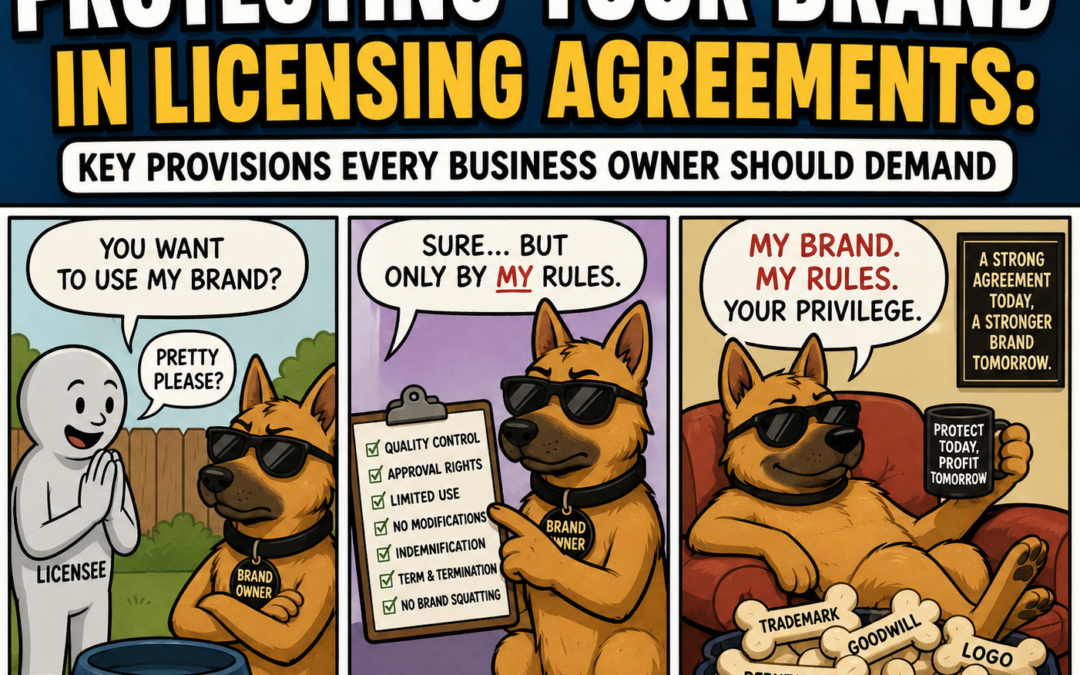
Your brand is often one of your company’s most valuable assets. Your business name, logo, slogans, product designs, and trademarks represent years of goodwill, customer recognition, and market reputation. When another party seeks permission to use those assets through a licensing agreement, the stakes are high. A poorly drafted license can dilute your brand, weaken your intellectual property rights, and create costly disputes over ownership and control.
Whether you are licensing your trademark to a distributor, franchisee, manufacturer, influencer, affiliate, or strategic partner, the agreement must be carefully structured to preserve your superior ownership rights and protect the integrity of your brand.
Below are the essential provisions every trademark or brand owner should insist upon in a licensing agreement.
- Clearly Confirm Ownership of Intellectual Property
The agreement should expressly state that all trademarks, logos, trade names, service marks, copyrighted materials, and associated goodwill remain the exclusive property of the licensor.
This provision may seem obvious, but ambiguity creates risk. Without a clear ownership clause, a licensee may later argue they acquired rights through use, investment, or market development.
The agreement should specify:
- The licensor retains all ownership rights;
- No ownership interest is transferred to the licensee;
- The licensee acquires only a limited right to use the intellectual property;
- Any goodwill generated by the licensee’s use belongs solely to the licensor.
A strong ownership clause helps prevent future claims of co-ownership or equitable rights.
- Define Exactly What Is Being Licensed
One of the most common drafting mistakes is using vague language such as “brand assets” or “marketing materials” without specificity.
The agreement should precisely identify:
- Registered trademarks;
- Pending trademark applications;
- Logos and stylized marks;
- Trade dress;
- Slogans;
- Domain names;
- Social media identifiers;
- Copyrighted materials;
- Marketing collateral;
- Product packaging designs.
Include exhibits or schedules identifying the marks and approved versions of logos to avoid later disputes over unauthorized modifications.
- Limit the Scope of Use
A licensing agreement should narrowly define how the licensee may use the intellectual property.
Important limitations include:
Geographic Restrictions
Specify where the marks may be used:
- United States only;
- Certain states or territories;
- International markets;
- Online sales restrictions.
Industry or Product Restrictions
Limit use to approved goods or services:
- Apparel only;
- Food products only;
- Software services only.
Channel Restrictions
Control where the products or services may appear:
- Retail stores;
- E-commerce only;
- Approved distributors;
- No Amazon or third-party marketplaces.
Without these restrictions, a licensee may expand beyond the intended arrangement and damage your market positioning.
- Include Strict Quality Control Provisions
Trademark owners have a legal obligation to maintain quality control over licensed products and services. Failure to exercise sufficient control can result in “naked licensing,” which may weaken or even jeopardize trademark rights.
The agreement should REQUIRE:
- Prior approval of products and packaging;
- Approval rights over advertising and marketing materials;
- Brand usage guidelines;
- Quality standards;
- Inspection and audit rights;
- Rights to reject nonconforming materials.
You should also reserve the right to require corrective action if the licensee’s use harms your brand image or reputation.
Strong quality control language is one of the most important protections in any trademark license.
- Establish Detailed Brand Usage Guidelines
A licensing agreement should not merely allow use of the logo or trademark — it should regulate exactly how those assets are displayed.
Usage standards should address:
- Approved logo versions;
- Colors and formatting;
- Font usage;
- Placement requirements;
- Minimum size standards;
- Trademark symbol usage (™ or ®);
- Prohibited alterations;
- Co-branding limitations;
- Website and social media usage rules.
Many businesses attach a formal brand standards manual as an exhibit to the agreement.
Consistency is critical to maintaining trademark strength and consumer recognition.
- Prohibit Unauthorized Registrations
The agreement should expressly prohibit the licensee from:
- Registering similar trademarks;
- Registering domain names incorporating your mark;
- Creating confusingly similar branding;
- Filing trademark applications in any jurisdiction;
- Claiming ownership rights in derivative branding.
You should also require the licensee to immediately assign to you any mistakenly acquired rights or registrations.
This provision is especially important in international licensing arrangements where “trademark squatting” can occur.
- Control Digital and Social Media Usage
Modern licensing agreements must address digital assets specifically.
The agreement should define:
- Who owns social media accounts;
- Who controls usernames and handles;
- Whether the licensee may create branded websites;
- Search engine advertising restrictions;
- Domain name ownership;
- Rules for influencer or affiliate marketing.
You should prohibit the licensee from:
- Using the mark in paid keyword advertising without consent;
- Creating unauthorized social media profiles;
- Modifying approved digital branding.
Digital misuse can rapidly damage brand reputation and create consumer confusion.
- Include Approval Rights for Marketing and Advertising
You should retain approval authority over:
- Advertising campaigns;
- Promotional materials;
- Public statements;
- Press releases;
- Product launches;
- Sponsorships;
- Influencer collaborations.
A licensee’s aggressive or careless marketing can expose the brand owner to reputational harm and even legal liability.
Pre-approval rights help preserve consistency and protect goodwill.
- Require Indemnification and Insurance
A licensee’s conduct can expose the trademark owner to lawsuits involving:
- Product defects;
- False advertising;
- Consumer claims;
- Regulatory violations;
- Intellectual property infringement allegations.
The agreement should require the licensee to:
- Indemnify the licensor;
- Defend claims arising from the licensee’s conduct;
- Maintain adequate insurance coverage;
- Name the licensor as an additional insured.
Insurance requirements should be tailored to the nature of the licensed products or services.
- Include Audit and Inspection Rights
The licensor should have the right to:
- Inspect facilities;
- Review products;
- Audit royalty records;
- Verify compliance;
- Monitor marketing practices.
Without audit rights, enforcement becomes significantly more difficult.
These provisions also discourage underreporting and unauthorized activities.
- Carefully Define Termination Rights
Your agreement should allow immediate termination if the licensee:
- Misuses the trademark;
- Violates brand standards;
- Damages brand reputation;
- Fails quality inspections;
- Breaches confidentiality;
- Becomes insolvent;
- Challenges ownership rights.
You should also include:
- Post-termination cease-and-desist obligations;
- Destruction or return of branded materials;
- Transfer of domains or social media accounts;
- Removal of all online references.
Prompt termination rights are essential when brand reputation is at risk.
- Prohibit Challenges to Ownership
The agreement should include a “no contest” clause prohibiting the licensee from:
- Challenging trademark validity;
- Contesting ownership;
- Assisting third parties in disputes;
- Claiming adverse rights.
While enforceability varies by jurisdiction, these clauses provide important contractual protection.
- Preserve Rights to Future Expansion
A poorly drafted license may unintentionally limit the owner’s ability to expand the brand.
Reserve the right to:
- License others;
- Enter adjacent markets;
- Modify branding;
- Develop new products;
- Expand geographically.
The agreement should confirm the license is limited and nonexclusive unless exclusivity is specifically intended.
- Address Intellectual Property Created During the Relationship
Disputes frequently arise over:
- Modified logos;
- New marketing materials;
- Product designs;
- Derivative works;
- Co-branded materials.
The agreement should state:
- Who owns newly created intellectual property;
- Whether derivative works automatically belong to the licensor;
- Whether assignments are required.
Failing to address derivative ownership can lead to costly litigation later.
- Protect Confidential Information and Trade Secrets
Licensing relationships often involve disclosure of:
- Marketing strategies;
- Customer information;
- Manufacturing methods;
- Pricing models;
- Proprietary processes.
The agreement should include robust confidentiality provisions and clearly define protected information.
Where applicable, trade secret protections should survive termination indefinitely.
Final Thoughts
Licensing your brand can create valuable revenue opportunities and expand market reach, but it also carries significant legal and reputational risks. A trademark or brand owner who fails to maintain control over how intellectual property is used may inadvertently weaken the very rights they worked hard to build.
A carefully drafted licensing agreement should do more than authorize use — it should preserve ownership, maintain quality standards, control brand presentation, and provide clear enforcement mechanisms in the event of problems.
Businesses should work with experienced intellectual property counsel to ensure licensing agreements are tailored to the specific industry, market, and long-term brand strategy involved.
Your brand is not just a logo. It is your reputation, your goodwill, and your competitive identity. Protect it accordingly.
Contact us today before letting someone use your brand without the right protections.
Author: Kelly Roberts
Attorney Kelly Roberts brings over fifteen years of focused experience helping business owners turn legal complexities into opportunities. From forming a new company to negotiating contracts, structuring partnerships, or buying and selling businesses, Kelly provides practical, results-driven legal guidance. Kelly earned her Juris Doctorate from the University of Miami School of Law.
Disclaimer: The information in this blog post (“post”) is provided for general informational purposes only and may not reflect the current law in your jurisdiction or the jurisdiction applicable to your issue/matter. No information contained in this post should be construed as legal advice from Roberts Law, PLLC or the individual author, nor is it intended to be a substitute for legal counsel on any subject matter. No reader of this post should act or refrain from acting on the basis of any information included in, or accessible through, this Post without seeking the appropriate legal or other professional advice on the particular facts and circumstances at issue from a lawyer licensed in the recipient’s state, country or other appropriate licensing jurisdiction.