
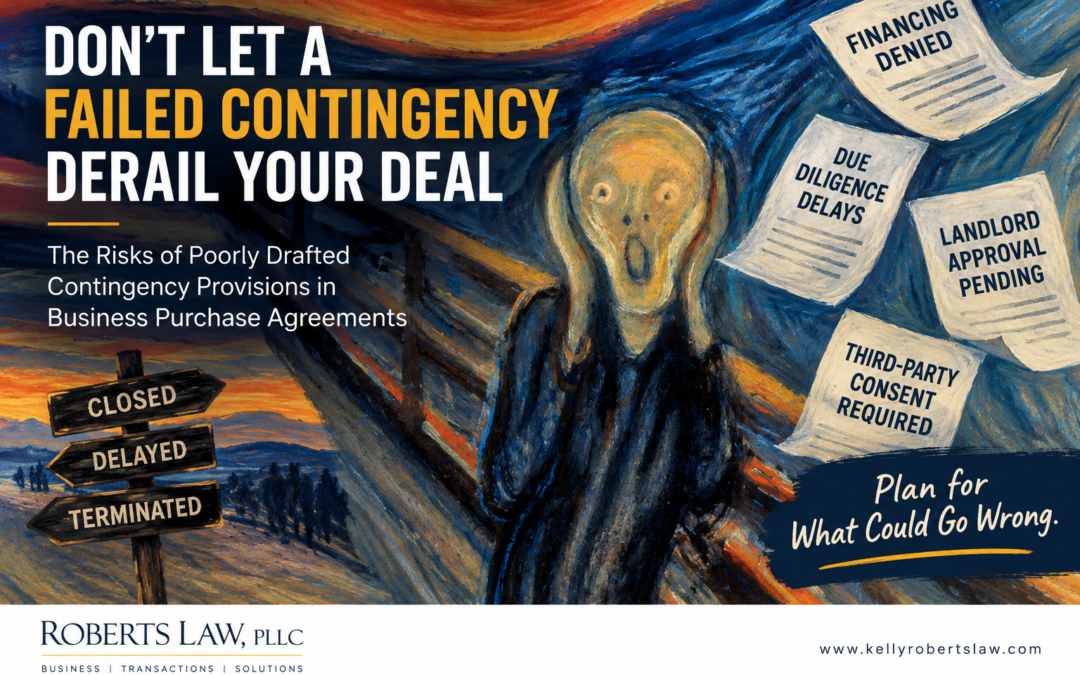
Buying a business often requires several pieces to fall into place before the transaction can close. The buyer may need financing approval, satisfactory due diligence, a new lease or landlord consent, governmental licenses, franchise or vendor approvals, or other third-party consents.
Purchase agreements commonly address these uncertainties through contingencies or conditions to closing. But simply stating that a purchase is “contingent upon financing,” “subject to due diligence,” or “subject to landlord approval” may not provide the protection a buyer expects.
A poorly drafted closing contingencies can create uncertainty at the exact moment the buyer has the most at risk: after spending significant time and money on the transaction but before the purchase closes.
A Contingency Needs More Than a Label
Consider a purchase agreement stating:
“This Agreement is contingent upon Buyer obtaining satisfactory financing.”
At first glance, that sounds protective. But it leaves important questions unanswered.
What financing must the buyer obtain? How long does the buyer have to obtain it? Must the buyer apply to a particular lender or accept any financing offered? What happens if the lender approves the loan but imposes conditions the buyer cannot satisfy? What if the lender is ready to fund but needs another two weeks? Can the seller terminate? Does the buyer receive its deposit back? Who decides whether the financing is “satisfactory”?
The same problems arise with due diligence and third-party consent provisions.
A provision stating that the transaction is “subject to landlord approval” does not necessarily explain what happens if the landlord delays responding, requires a new lease on materially different terms, demands additional security, or refuses consent altogether.
The language may identify the problem without providing the solution.
Deadlines Matter
A well-drafted closing contingencies should establish a workable timeline.
For example, a financing contingency may need to address when the buyer must apply, how long the buyer has to obtain approval, whether the buyer must provide notice if financing cannot be obtained, and whether the closing date is automatically or optionally extended if financing is substantially complete but funding is delayed.
Due diligence provisions present similar issues. The agreement should clearly identify when the diligence period begins and ends, what information the seller must provide, and what happens if critical information is not delivered until shortly before the deadline.
Without clear timelines, the parties can disagree over whether closing contingencies have expired, whether they were properly exercised, or whether one party caused a delay.
The Agreement Should Address What Happens When Something Goes Wrong
Identifying a contingency is only part of the drafting process. The agreement should also address the consequences if the contingency is not satisfied.
Depending on the transaction, that may include:
- termination rights;
- return or forfeiture of deposits;
- extensions of the contingency or closing period;
- waiver rights;
- requirements for written notice;
- obligations to continue cooperating;
- allocation of third-party costs; and
- remedies if one party prevents or delays satisfaction of the contingency.
These provisions matter most when the buyer has already incurred lender fees, legal fees, accounting expenses, inspection costs, licensing expenses, or other transaction costs.
Third-Party Consents Can Be Especially Difficult
Many business acquisitions depend on people or entities that are not parties to the purchase agreement.
A landlord may need to consent to an assignment of the existing lease or approve a new lease. A franchisor may need to approve the buyer. A lender may impose additional closing requirements. A government agency may need to issue a license. A critical vendor may need to consent to assignment of a contract or dealership territory.
Because neither the buyer nor seller completely controls these third parties, the purchase agreement should anticipate delay, additional requirements, and even refusal.
For example, if landlord approval is required, the agreement should consider not only whether consent is obtained but whether the terms imposed by the landlord are acceptable. A landlord’s willingness to enter into a new lease at substantially higher rent or on materially different terms may technically constitute an “approval,” but it may not be the deal the buyer agreed to pursue.
Due Diligence Provisions Require the Same Precision
Vague drafting can undermine a buyer’s due diligence rights.
An agreement may give the buyer 30 days for due diligence, but that protection can be significantly less useful if the seller does not have to produce financial statements, contracts, employee information, tax records, equipment lists, leases, licenses, or other requested materials within a specified period.
The agreement should also make clear what rights the buyer has after reviewing that information. Depending on the transaction, the buyer may have the right to terminate in its discretion during the diligence period, require identified problems to be corrected, renegotiate certain terms, or proceed notwithstanding the issue.
The purchase agreement should say what the parties intend rather than leaving those questions for a dispute after a problem develops.
Extensions Should Be Addressed Before They Are Needed
Another common problem occurs when everyone still wants to close, but one of the closing contingencies cannot be completed by the scheduled closing date.
The SBA lender needs another week. The landlord’s attorney has not completed the lease. A license remains pending. A third-party consent is sitting with a corporate approval department.
If the agreement does not address extensions, the parties may suddenly be negotiating from very different positions. The seller may have the right to terminate, demand additional money, retain a deposit, or insist upon other concessions in exchange for additional time.
An appropriately drafted agreement can provide a defined extension mechanism for specified circumstances, including the length of the extension, who may exercise it, what notice is required, and whether additional deposits or other conditions apply.
Dispute Resolution Matters Too
Even carefully drafted agreements cannot eliminate every disagreement. The purchase agreement should therefore address how disputes concerning contingencies will be handled.
For example, what happens if the seller believes the buyer failed to make reasonable efforts to obtain financing, while the buyer believes the financing contingency was not satisfied? What if the buyer terminates based on due diligence and the seller disputes the buyer’s right to the deposit?
The agreement should address applicable law, venue, mediation or arbitration if appropriate, attorneys’ fees where applicable, and procedures concerning disputed escrowed funds.
Those provisions may seem secondary while everyone is working toward closing. They become much more important when a transaction does not proceed as planned.
Good Purchase Agreements Plan for the Deal That Does Not Go Perfectly
When a transaction is moving smoothly, vague contract language may never become an issue. The value of careful drafting becomes apparent when something goes wrong.
A well-drafted purchase agreement should establish not only what must happen before closing, but also who is responsible for making it happen, when it must happen, what constitutes satisfaction of the requirement, what happens if it is delayed, and what rights each party has if it never happens.
Those details can determine whether a buyer can safely terminate a transaction, recover a deposit, get additional time to close, or avoid being required to purchase a business when a critical component of the transaction falls through.
For buyers, addressing these issues before signing the purchase agreement is generally far easier—and less expensive—than trying to resolve them after a contingency has failed.
Roberts Law, PLLC assists business owners and purchasers with business acquisitions, including preparing and negotiating purchase agreements, due diligence and closing requirements, transaction documents, and closing services. Careful planning at the start of a transaction can help identify potential obstacles and establish clear procedures to address them before they jeopardize the closing.
This article is provided for general informational purposes only and does not constitute legal advice. The appropriate terms of a purchase agreement depend upon the particular transaction and circumstances. Roberts Law, PLLC does not provide tax or accounting advice.