
Merchant Cash Advances: What Every Business Owner Should Know
When cash flow becomes tight, every business owner starts looking for solutions. Payroll is due, inventory needs to be purchased, equipment breaks, or an unexpected opportunity requires immediate capital. In those moments, Merchant Cash Advance (“MCA”) companies often promise exactly what struggling businesses want to hear:
“Fast approvals. No collateral. Funding in 24 hours.”
While the money may arrive quickly, many business owners later discover that the true cost of that financing is far greater than they anticipated.
At Roberts Law, PLLC, we regularly work with local businesses to improve their operations, with business sales, and sometimes bankruptcy matters. One common issue we see is a business that was already facing cash flow challenges becoming overwhelmed after taking on one or more Merchant Cash Advances.
Before signing an MCA agreement, it is important to understand exactly what you are agreeing to.
What Is a Merchant Cash Advance?
A Merchant Cash Advance is a financing arrangement in which a company provides a business with an upfront lump sum of money in exchange for the right to receive a portion of the business’s future sales or receivables.
Unlike a traditional bank loan, the financing company typically purchases future receivables at a discount.
For example:
- Business receives: $100,000
- Amount to be repaid: $135,000
- Difference ($35,000) is the financing company’s profit or “factor.”
Instead of charging traditional interest, most MCA companies use a factor rate, commonly ranging from 1.15 to 1.50 or more.
That distinction may sound minor—but it can dramatically increase the actual cost of borrowing.
Is a Merchant Cash Advance Actually a Loan?
Legally, the answer is: it depends.
Most MCA companies intentionally structure these transactions as a purchase and sale of future receivables rather than a loan. Their agreements often state that they are purchasing future revenue instead of lending money.
Why?
Because if the transaction is characterized as a sale rather than a loan, the MCA company may argue that many state lending laws—including certain usury statutes—do not apply.
However, courts look beyond the title of the agreement. If the arrangement functions like a loan with mandatory repayment regardless of business performance, a court may determine that it is actually a loan.
Whether an MCA is legally enforceable as a true receivables purchase depends on the specific contract language and applicable state law.
How Does a Merchant Cash Advance Typically Work?
Although every agreement differs, the process generally follows the same pattern:
- Business submits recent bank statements and sales history.
- MCA company approves funding—sometimes within hours.
- Business receives a lump sum.
- MCA company begins automatically withdrawing money from the business bank account.
Unlike traditional monthly loan payments, many MCA agreements require:
- Daily ACH withdrawals
- Every-business-day payments
- Weekly withdrawals
- Automatic debits directly from credit card processing
Some businesses may have money withdrawn five or even seven days every week.
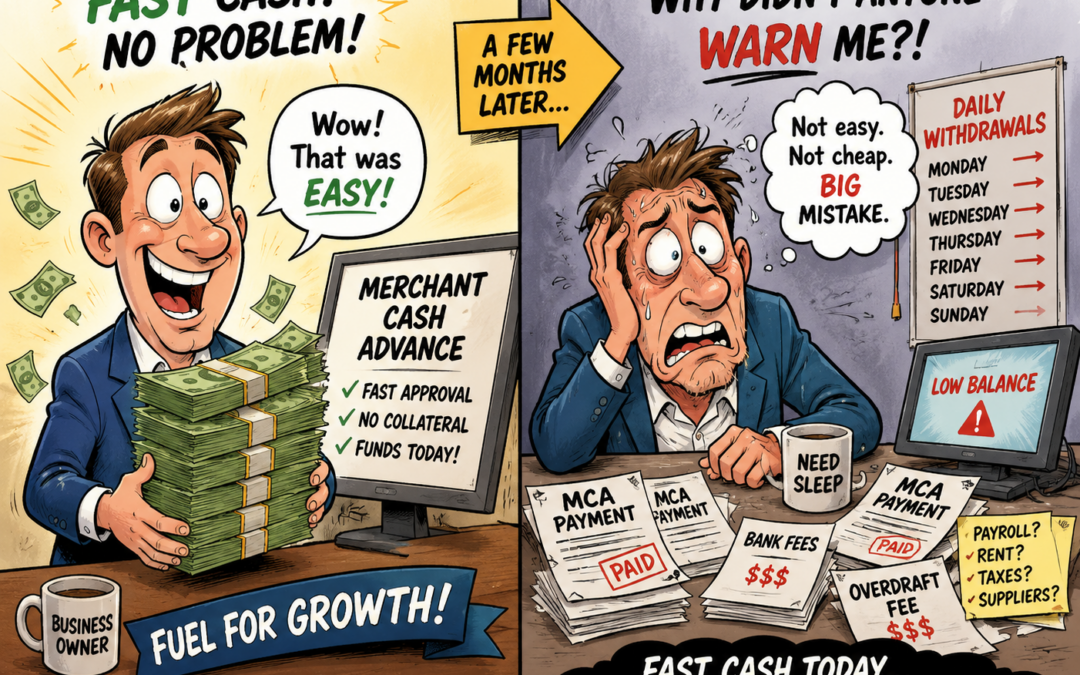
The Hidden Problem: Daily Payments
The frequency of repayment is often what causes the greatest financial strain.
Traditional commercial loans generally have monthly payments, allowing businesses time to generate revenue before the next payment is due.
Merchant Cash Advances frequently require money to leave the account every day.
That means:
- payroll is competing with MCA payments;
- rent is competing with MCA payments;
- vendor payments are competing with MCA payments; and
- taxes are competing with MCA payments.
Businesses experiencing seasonal fluctuations or temporary cash flow issues often find themselves in a constant cycle of trying to keep enough money in the account to avoid overdrafts while meeting daily withdrawals.
The Real Cost Can Be Much Higher Than It Appears
Many business owners focus on the factor rate rather than the actual cost of capital.
For example:
Business receives $100,000.
Business agrees to repay $135,000 over approximately eight months through daily withdrawals.
Although the agreement may advertise a 1.35 factor, the effective annual cost can be dramatically higher than many conventional commercial loans because the money is repaid so quickly.
The shorter the repayment period, the higher the effective annual financing cost.
Many business owners never calculate this number before signing.
When One MCA Becomes Two…Then Three
One of the greatest dangers is what happens after the first Merchant Cash Advance. Daily withdrawals reduce available cash. The business then struggles to meet operating expenses. Another MCA company offers additional funding. The second advance is used to cover the first. Then a third. Sometimes a fourth.
This practice—often called “stacking”—can create an unsustainable cycle where multiple financing companies are withdrawing funds from the same operating account every day. Instead of solving the cash flow problem, the financing compounds it.
How Merchant Cash Advances Can Threaten the Survival of a Business
Merchant Cash Advances are not inherently inappropriate. In limited circumstances, they may provide short-term working capital for businesses with strong, predictable revenue and a realistic repayment strategy. However, for businesses already experiencing financial stress, an MCA can accelerate a crisis.
Potential consequences include:
- Chronic cash flow shortages.
- Inability to make payroll.
- Missed vendor payments.
- Tax delinquencies.
- Overdraft fees.
- Defaults under bank loan agreements.
- Breach of commercial lease obligations.
- Loss of key supplier relationships.
- Multiple MCA obligations competing for the same revenue.
- Increased risk of litigation, judgments, and collection actions.
- Greater likelihood of restructuring or bankruptcy.
By the time many owners seek legal counsel, they are juggling several Merchant Cash Advances simultaneously while trying to keep the business operating.
Questions to Ask Before Signing an MCA Agreement
Before accepting any Merchant Cash Advance, ask yourself—and the financing company—the following questions:
- What is the total dollar amount I will repay?
Do not focus solely on the amount you receive.
Ask: “Exactly how much money will leave my business before this obligation is satisfied?”
- How often will payments be withdrawn?
Daily? Weekly? Every business day? Automatic withdrawals can significantly impact your operating cash flow.
- What happens if revenue declines?
Can payments be adjusted? Is there a reconciliation process? How difficult is it to request one?
- Are there personal guarantees?
Many business owners are surprised to learn they may be personally liable if the business cannot meet its obligations.
- Are there confession of judgment provisions or aggressive collection remedies?
Some agreements include powerful enforcement rights that can significantly accelerate collection efforts in certain jurisdictions.
- Can I obtain financing elsewhere?
Traditional bank financing, SBA loans, business lines of credit, equipment financing, or even negotiating payment terms with vendors may ultimately be less expensive.
- What happens if I need another advance?
If your business plan already assumes obtaining another Merchant Cash Advance to repay the first one, that should be a significant warning sign.
- Have I had an attorney review the agreement?
These contracts are often lengthy, technical, and heavily weighted in favor of the financing company. A legal review before signing can identify provisions that create significant financial and legal risk.
There May Be Better Alternatives
Before entering into an MCA agreement, consider exploring alternatives such as:
- Traditional commercial loans.
- SBA financing.
- Business lines of credit.
- Equipment financing.
- Accounts receivable financing.
- Equity investment.
- Vendor payment negotiations.
- Business restructuring or workout negotiations.
The right solution depends on your business’s financial condition and long-term objectives.
The Bottom Line
Fast money can be very expensive.
Merchant Cash Advances can provide immediate access to capital, but they often come with repayment structures that place extraordinary pressure on a business’s cash flow. What appears to be a short-term solution can quickly become a long-term problem—especially when multiple advances are involved.
Before signing any financing agreement, take the time to understand the true cost, the repayment obligations, and the legal consequences. A careful review today may help protect the business you have spent years building.
The best time to seek legal advice is before you sign—not after the withdrawals begin.
Author: Kelly Roberts
Attorney Kelly Roberts brings over fifteen years of focused experience helping business owners turn legal complexities into opportunities. From forming a new company to negotiating contracts, structuring partnerships, or buying and selling businesses, Kelly provides practical, results-driven legal guidance. Kelly earned her Juris Doctorate from the University of Miami School of Law.
Disclaimer: The information in this blog post (“post”) is provided for general informational purposes only and may not reflect the current law in your jurisdiction or the jurisdiction applicable to your issue/matter. No information contained in this post should be construed as legal advice from Roberts Law, PLLC, or the individual author, nor is it intended to be a substitute for legal counsel on any subject matter. No reader of this post should act or refrain from acting on the basis of any information included in, or accessible through, this Post without seeking the appropriate legal or other professional advice on the particular facts and circumstances at issue from a lawyer licensed in the recipient’s state, country, or other appropriate licensing jurisdiction.